
Battery pack
When does a pack in a sealed box pass 60 C?
You ask
Will this battery pack overheat in a sealed box during a one hour discharge?
Wobbl runs
$ wobbl thermal pack.py -m li-ion-cell --power "6 W" \ --film "5 W/m2K @ all" --ambient "35 C" --radiation 0.9 \ --duration "60 min" --limit "60 C"Checks
- passmesh convergence
- passenergy balance
- passhand calculation
- passunits and sanity
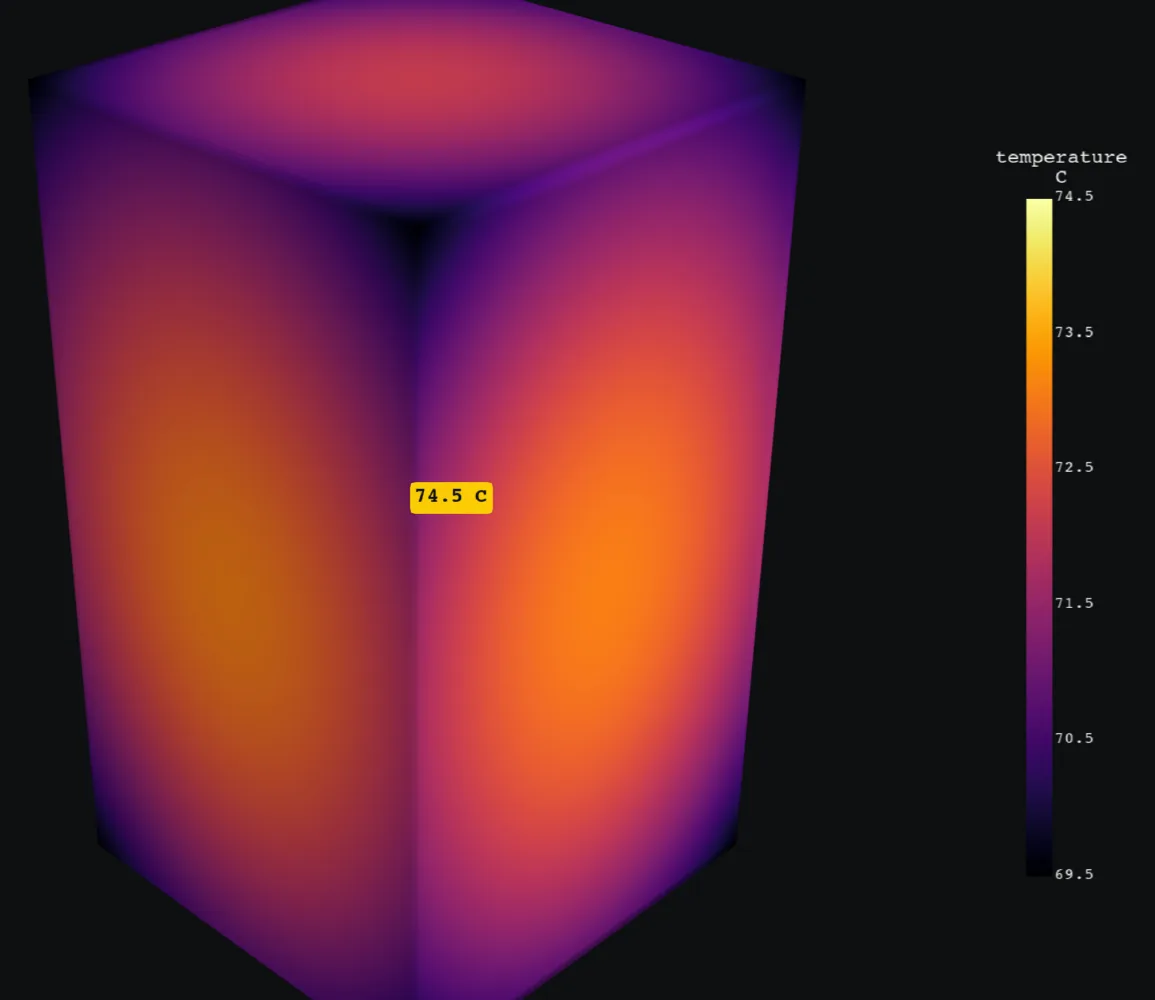
HOTHottest point reaches 74.5 C (limit 60 C) at (18.5, 18.5, 31.8) mm after 60 min. It passes 60 C after about 21.1 min.
- Max temperature
- 74.5 C
- Limit
- 60 C
- Power
- 6 W
- Confidence
- high
Suggested fixes
- Raise heat transfer about 2x
- Cut the power to 3.04 W
summary.txt
HOT. Hottest point reaches 74.5 C (limit 60 C) at (18.5, 18.5, 31.8) mm after 60 min. It passes 60 C after about 21.1 min. Confidence: high. passed mesh convergence, energy balance, hand calculation, units and sanitymax temperature: 74.5 Climit: 60 Cpower: 6 Wmesh nodes: 9,610 Checks: [pass] mesh convergence: temperature rise at the hottest point settled: 39.5 -> 39.5 C over 2 meshes, last change 0.0% [pass] energy balance: over 60 min, heat in 21.6 kJ, stored 7.98 kJ, out through the surfaces 13.4 kJ (1% apart) [pass] hand calculation: lumped model with convection and radiation (Biot 0.012) gives a mean of 72.2 C at the end; FEA mean is 72.8 C (1.6% of the rise) [pass] units and sanity: temperatures between 69.5 and 74.5 C Assumptions: - Li-ion cell (lumped, effective): conductivity 3 W/(m K), specific heat 950 J/(kg K), density 2500 kg/m3. - Heat is generated evenly through the part. - Convection uses a fixed film coefficient; real coefficients vary with temperature and airflow. - Surrounding air or coolant at 35 C does not heat up. - Radiation with emissivity 0.9. - Contact resistance between parts and internal airflow are not modeled. Suggested fixes: - Raise heat transfer about 2x: The temperature rise scales with 1/(h A). A small fan takes h from about 5 to 25 W/(m2 K); fins or a larger case add area. Either way you need about 2x the current 5 W/(m2 K) times area. - Cut the power to 3.04 W: Lower current or duty cycle; the rise is proportional to the heat made. Images: temperature: images/temperature.png, history: images/history.pngReport: report.htmlAbout this example
This 2S2P pack of 18650 cells is treated as one 37 x 37 x 65 mm block with effective cell properties, and it makes 6 W during a one hour discharge inside a sealed plastic box at 35 C. Still air gives about 5 W/(m2 K), and the wrap radiates with an emissivity of 0.9.
| Result | Value |
|---|---|
| Hottest point after 60 min | 74.5 C, over the 60 C limit for Li-ion cells |
| Time to pass 60 C | about 21 minutes |
| Hand calculation | a lumped model with convection and radiation gives a mean of 72.2 C at 60 min, and the FEA mean is 72.8 C |
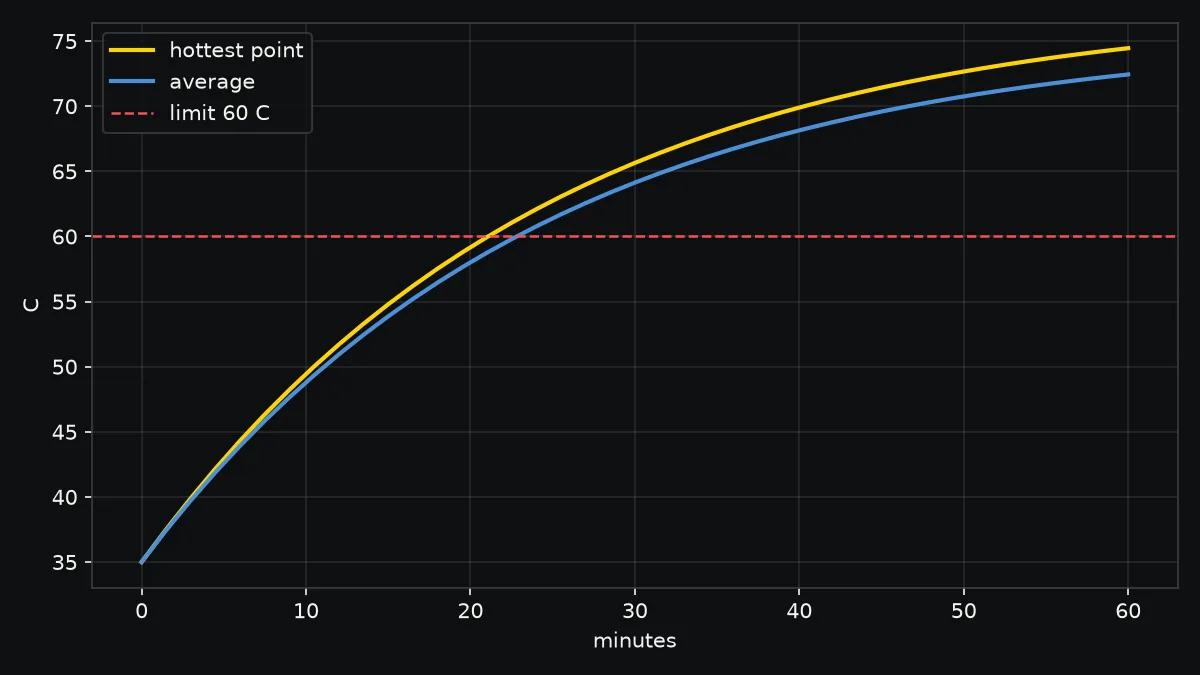
The pack heats almost uniformly (Biot number 0.012), so the answer is set by how fast the box sheds heat. Wobbl suggests roughly doubling the heat transfer, with airflow or a thermal path to a metal wall, or cutting the heat to about 3 W, which keeps the pack near 55 C with some margin under the limit.
Run it yourself
$ git clone https://github.com/sohan-bhat/wobbl$ cd wobbl/examples/battery-pack && ./run.shThe part, the script and every output are in examples/battery-pack on GitHub.