
Rocket launch
Will an L class rocket fly straight, reach 11,000 ft and land softly in a 10 mph wind?
You ask
Will this L class rocket fly straight, reach 11,000 ft and land softly in a 10 mph wind?
Wobbl runs
$ wobbl motion rocket.tomlModeled6 state variables
- gravity falling off with altitude
- 1976 standard atmosphere
- air drag
- transonic drag rise
- wind
- launch rail
- thrust curve
- propellant burn
- weathercocking
- drogue parachute
- main parachute
Checks
- passstep convergence
- passdelta v budget
- passparachute descent
- passenergy balance
- passunits and sanity
- passstability margin
- passrail exit speed
- infomax dynamic pressure
- infomax acceleration
- passapogee
- passlanding speed
- infodrift
Events
| Event | Time | Altitude | Speed |
|---|---|---|---|
| Liftoff | 0.0014 s | 0 m | 0 m/s |
| Rail exit | 0.173 s | 2.4 m | 30.6 m/s |
| Burnout | 2.65 s | 647 m | 419 m/s |
| Apogee | 23.5 s | 3,439 m | 23.1 m/s |
| Drogue deploy | 23.5 s | 3,439 m | 23.1 m/s |
| Main deploy | 178 s | 150 m | 20.4 m/s |
| Landing | 203 s | 0 m | 7.26 m/s |
OKReaches 3439 m (11284 ft) at Mach 1.27 and lands 29.3 m upwind of the pad at 5.72 m/s, with a 1.88 caliber margin and 30.6 m/s off the rail.
- Apogee
- 3439 m
- Max Mach
- 1.27
- Stability
- 1.88 cal
- Confidence
- high
summary.txt
OK. Reaches 3439 m (11284 ft) at Mach 1.27 and lands 29.3 m upwind of the pad at 5.72 m/s, with a 1.88 caliber margin and 30.6 m/s off the rail. Confidence: high. passed step convergence, delta v budget, parachute descent, energy balance, units and sanityapogee: 3439 mmax Mach: 1.27stability: 1.88 caloff the rail: 30.6 m/slanding: 5.72 m/sdrift: 29.3 m Checks: [pass] step convergence: flown again with a tolerance ten times tighter, the flight time 203 s, apogee 3439 m, burnout speed 419 m/s, max Mach 1.27, landing speed 5.72 m/s and drift 29.3 m moved by at most 0.0098% (the drift) [pass] delta v budget: Tsiolkovsky gives 541 m/s from a 2007 m/s exhaust speed and a mass ratio of 1.31. Gravity takes 25.7 m/s, drag 96.9 m/s and steering 0.0863 m/s, which leaves 419 m/s, and the flight reaches 419 m/s at burnout (7.2e-10% apart) [pass] parachute descent: Under the drogue sqrt(2 m g / (rho Cd A)) gives 19.9 m/s at 150 m and the flight sinks at 19.9 m/s there. Under the drogue and main it gives 5.72 m/s at the ground against 5.72 m/s from the run (0.097% apart at most) [pass] energy balance: thrust did 867 kJ of work, drag took 798 kJ, gravity took 3.43 kJ and the burned propellant carried off 65.6 kJ, which leaves 160 J of kinetic energy at landing, and the landing speed carries 160 J (apart by 4.4e-06% of the largest term) [pass] units and sanity: speeds stay under Mach 1.27, all 1.88 kg of propellant burned, an average thrust 18.3 times the liftoff weight, 7.95 kg in a 98 mm by 2.1 m tube, 502 kg/m3 on average [pass] stability margin: 1.88 calibers at liftoff, the center of pressure 1.54 m from the nose tip and the balance point 1.36 m, rising to 3.38 at burnout as the propellant burns away. Barrowman's method holds below about Mach 0.8 [pass] rail exit speed: 30.6 m/s after 2.44 m of rail, above the 15 m/s the fins need to steer [info] max dynamic pressure: 106 kPa at Mach 1.27 and 574 m, 2.48 s after ignition, the load the fins and their joints have to carry without fluttering [info] max acceleration: 20.8 g (204 m/s2) at 0.03 s under thrust. The drogue opens with 1.3 g of drag, pulling 79.2 N on its harness. The main opens with 3.6 g of drag, pulling 214 N on its harness [pass] apogee: 3439 m (11284 ft) above the ground at 23.5 s, 2.6% over the 3353 m target [pass] landing speed: descends at 5.72 m/s under the drogue and main, under the 6.1 m/s limit, and with the wind it moves 7.26 m/s over the ground [info] drift: lands 29.3 m upwind of the pad in a 4.47 m/s wind, after reaching 757 m upwind at apogee. The descent from apogee takes 179 s Assumptions: - A point mass in a vertical plane, so it does not spin, tumble or move sideways, and its drag acts against the air rushing past it. - Drag coefficient 0.45 below Mach 0.6, raised through the transonic range to 0.765 near Mach 1.1 by a generic curve for a slender finned rocket, the same whether the motor burns or not. - The 1976 US standard atmosphere from 0 m above sea level, a standard day. - Gravity falls off with the square of the distance to the Earth's center, over a flat Earth that does not rotate. - A steady wind of 4.47 m/s at every height, blowing back toward the start. - Thrust follows the 75 mm L class curve in straight lines between its points, 3773 N s over 2.65 s, and propellant burns in proportion to thrust, so all 1.88 kg is gone at burnout. - The rocket travels the full 2.44 m of rail before it leaves it, tilted 5 deg from vertical. - Off the rail it turns into the wind it feels at its weathercock frequency, from Barrowman's normal force and margin and the pitch inertia of a uniform rod of its length and mass, with no lift at angle of attack and no overshoot. - Each parachute opens over the time it takes to travel eight of its diameters, its drag area growing with the square of time, and the drogue stays on under the main. - Under the parachutes only their drag counts, so the descent is slightly faster than with the airframe's drag added, which errs on the safe side for landing speed. Images: flight: images/flight.png, path: images/path.pngReport: report.htmlAbout this example
This is a level 2 high power rocket, a 98 mm fiberglass airframe 2.1 m long with an ogive nose and
three clipped delta fins, flying on a 75 mm L class motor of 3773 N s that burns for 2.65 s. It
weighs 7.95 kg on the pad and leaves an 8 ft rail tilted 5 degrees into a 10 mph wind. An altimeter
fires an 18 inch drogue at apogee and a 60 inch main at 150 m on the way down. Everything is in
rocket.toml, with comments on the values that need them.
| Result | Value |
|---|---|
| Apogee | 3439 m (11284 ft) at 23.5 s, 2.6% over the 11,000 ft target |
| Top speed | 427 m/s, Mach 1.27, just before burnout at 2.65 s |
| Stability | 1.88 calibers off the rail by Barrowman’s method, rising to 3.38 as the propellant burns |
| Off the rail | 30.6 m/s, twice the 15 m/s the fins need to steer |
| Peak loads | 106 kPa of dynamic pressure at top speed and 20.8 g on the thrust peak |
| Descent | 19.9 m/s under the drogue, then 5.72 m/s under both parachutes |
| Landing | 29.3 m upwind of the pad, 203 s after ignition |
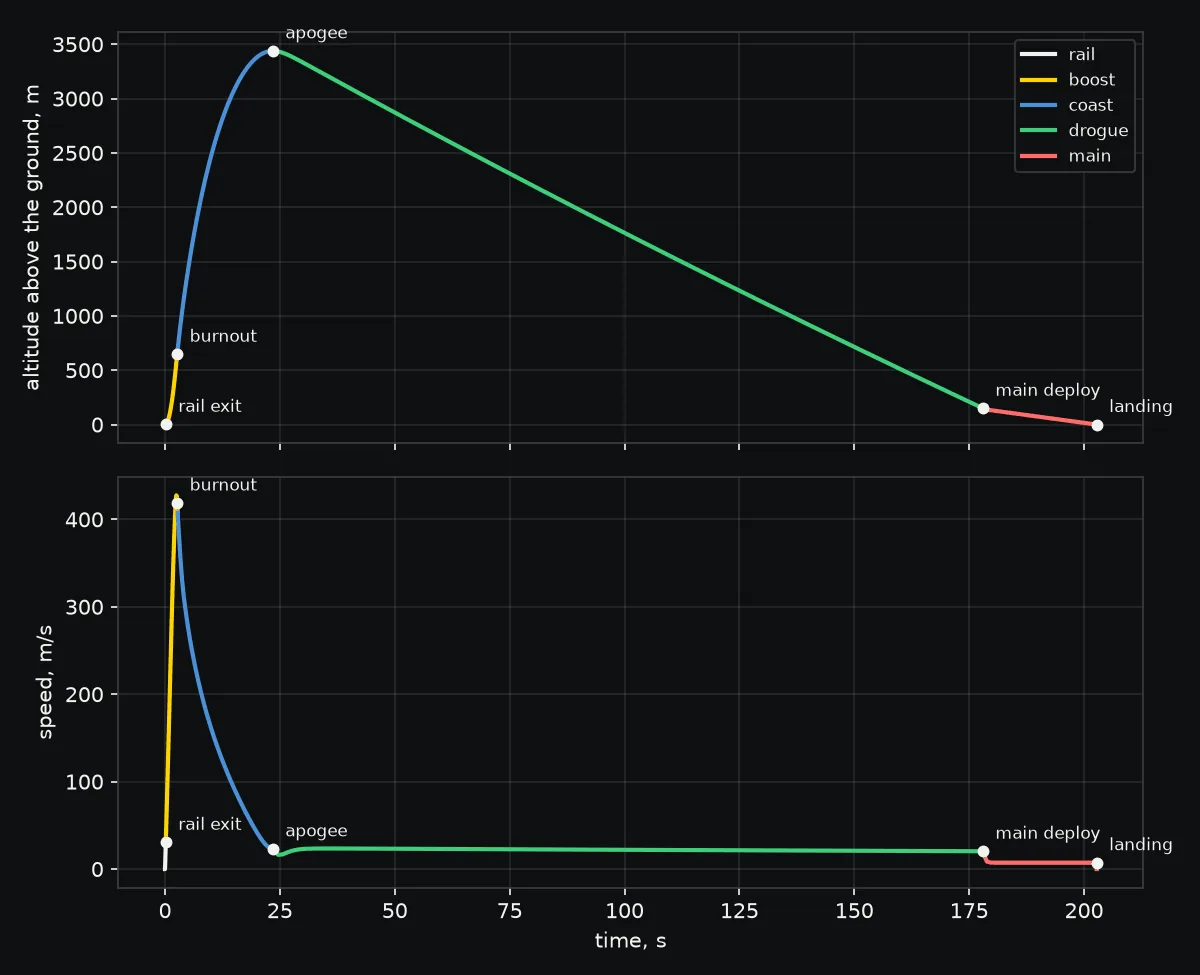
The rocket passes Mach 1 at 1.76 s. Through the transonic range its drag coefficient climbs from 0.45 to 0.77, and by burnout drag has taken 96.9 m/s of the 541 m/s the motor could give it. Off the rail it turns into the wind it feels, so it climbs upwind and is 757 m from the pad at apogee, and the wind carries it back during the three minute descent until it lands near where it started.
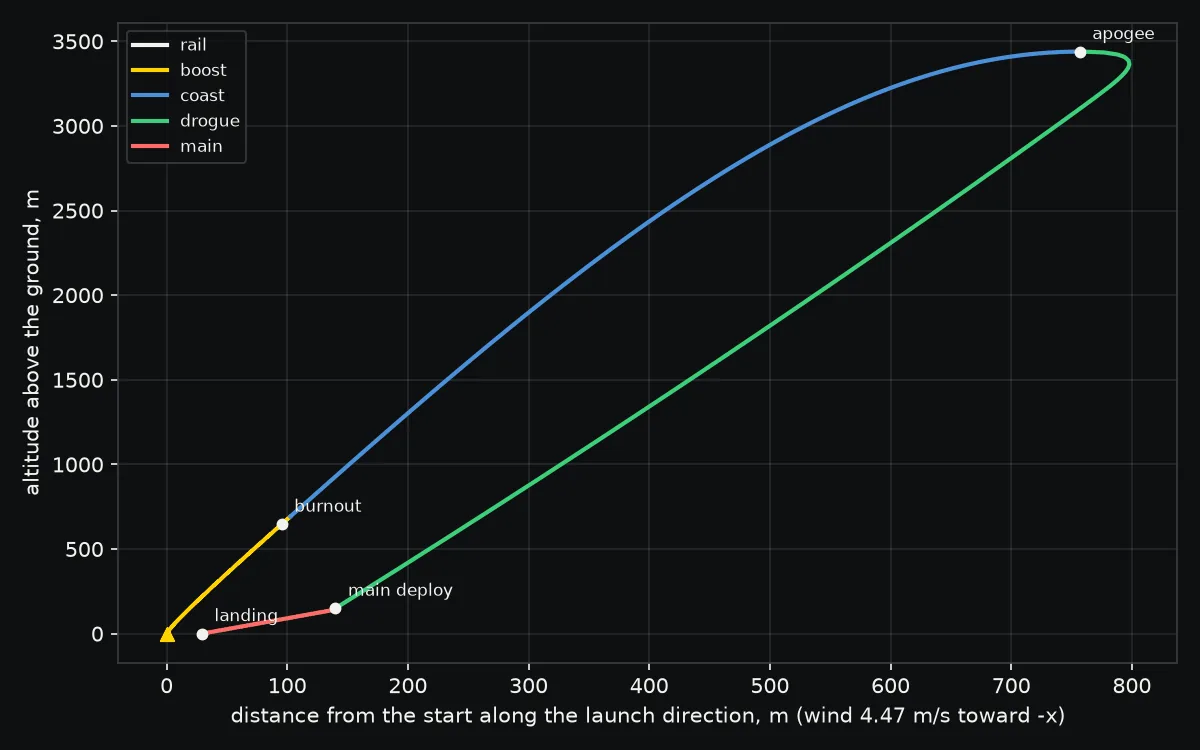
Wobbl checks itself on the way. Tsiolkovsky’s ideal delta v less what gravity, drag and steering took matches the speed at burnout, the work done by thrust, drag and gravity matches the change in kinetic energy, the sink rate under each parachute matches its terminal speed, and every number held when the flight was integrated again with a tolerance ten times tighter. The model is a point mass in a vertical plane that turns into the relative wind at its weathercock frequency, which is the usual depth for planning a flight but not a six degree of freedom simulation, and Barrowman’s method is subsonic, so the margin past Mach 1 needs a supersonic method. At 106 kPa it is also worth checking the fins for flutter.
The full flight is in output/trajectory.csv, at most 500 rows with one at every event, each with
time, downrange distance, altitude, speed, acceleration, mass, Mach number, dynamic pressure and phase.
Run it yourself
$ git clone https://github.com/sohan-bhat/wobbl$ cd wobbl/examples/rocket-launch && ./run.shThe part, the script and every output are in examples/rocket-launch on GitHub.