
Falling rock
How fast does a rock hit the ground after a 300 m fall?
You ask
How fast does a fist sized rock hit the ground after falling off a 300 m cliff?
Wobbl runs
$ wobbl motion --name rock --diameter "9 cm" --density "2700 kg/m3" \ --cd 0.6 --height "300 m"Modeled4 state variables
- gravity falling off with altitude
- 1976 standard atmosphere
- air drag
Checks
- passstep convergence
- passhand calculation
- passvacuum drop
- passenergy balance
- passunits and sanity
Events
| Event | Time | Altitude | Speed |
|---|---|---|---|
| Release | 0 s | 300 m | 0 m/s |
| Impact | 8.72 s | 0 m | 56.8 m/s |
OKHits the ground 8.72 s after release at 56.8 m/s (205 km/h). Without air it would land after 7.82 s at 76.7 m/s, so drag takes 26% off the impact speed.
- Fall time
- 8.72 s
- Impact speed
- 56.8 m/s
- Without air
- 7.82 s, 76.7 m/s
- Confidence
- high
summary.txt
OK. Hits the ground 8.72 s after release at 56.8 m/s (205 km/h). Without air it would land after 7.82 s at 76.7 m/s, so drag takes 26% off the impact speed. Confidence: high. passed step convergence, hand calculation, vacuum drop, energy balance, units and sanityfall time: 8.72 simpact speed: 56.8 m/swithout air: 7.82 s, 76.7 m/sterminal speed: 66.2 m/s Checks: [pass] step convergence: flown again with a tolerance ten times tighter, the flight time 8.72 s and impact speed 56.8 m/s moved by at most 1e-06% (the impact speed) [pass] hand calculation: with the air at its density halfway down (1.207 kg/m3) the terminal speed is 66.2 m/s, and v = vt tanh(g t / vt) with h = vt^2/g ln cosh(g t / vt) gives 8.719 s and 56.9 m/s against 8.717 s and 56.8 m/s from the run (0.16% apart), the difference coming from the air thickening on the way down [pass] vacuum drop: with the air taken away and gravity held at its ground value the run lands after 7.822 s at 76.7 m/s, and sqrt(2h/g) gives 7.822 s and 76.7 m/s (1.5e-13% apart). The air adds 0.895 s to the fall and takes 19.9 m/s off the impact [pass] energy balance: drag took 1.37 kJ and gravity gave 3.03 kJ, which leaves 1.66 kJ of kinetic energy at impact, and the impact speed carries 1.66 kJ (apart by 4.9e-07% of the largest term) [pass] units and sanity: speeds stay under Mach 0.167, 1.03 kg in a 9 cm body, 2700 kg/m3 for a sphere Assumptions: - A point mass in a vertical plane, so it does not spin, tumble or move sideways, and its drag acts against the air rushing past it. - Drag coefficient 0.6 on a frontal area 9 cm across, the same at every speed. - The 1976 US standard atmosphere from 0 m above sea level, a standard day. - Gravity falls off with the square of the distance to the Earth's center, over a flat Earth that does not rotate. - Still air. Images: flight: images/flight.pngReport: report.htmlAbout this example
This is the simplest thing Wobbl can simulate. A fist sized lump of granite, taken as a sphere 9 cm across at 2700 kg/m3 so it weighs 1.03 kg, drops from rest off the top of a 300 m cliff. A tumbling rock averages a drag coefficient of about 0.6 on its frontal area, and the air is the 1976 standard atmosphere, about 3% thinner at the top of the cliff than at its foot.
| Result | Value |
|---|---|
| Fall time | 8.72 s, against 7.82 s without air |
| Impact speed | 56.8 m/s (205 km/h), against 76.7 m/s without air |
| Terminal speed | 66.2 m/s, which the rock never quite reaches |
| Hand calculation | the quadratic drag solution, with the air’s density taken halfway down, gives 8.72 s and 56.9 m/s |
| Energy balance | gravity gives 3.03 kJ and drag takes 1.37 kJ, which leaves the 1.66 kJ the impact speed carries |
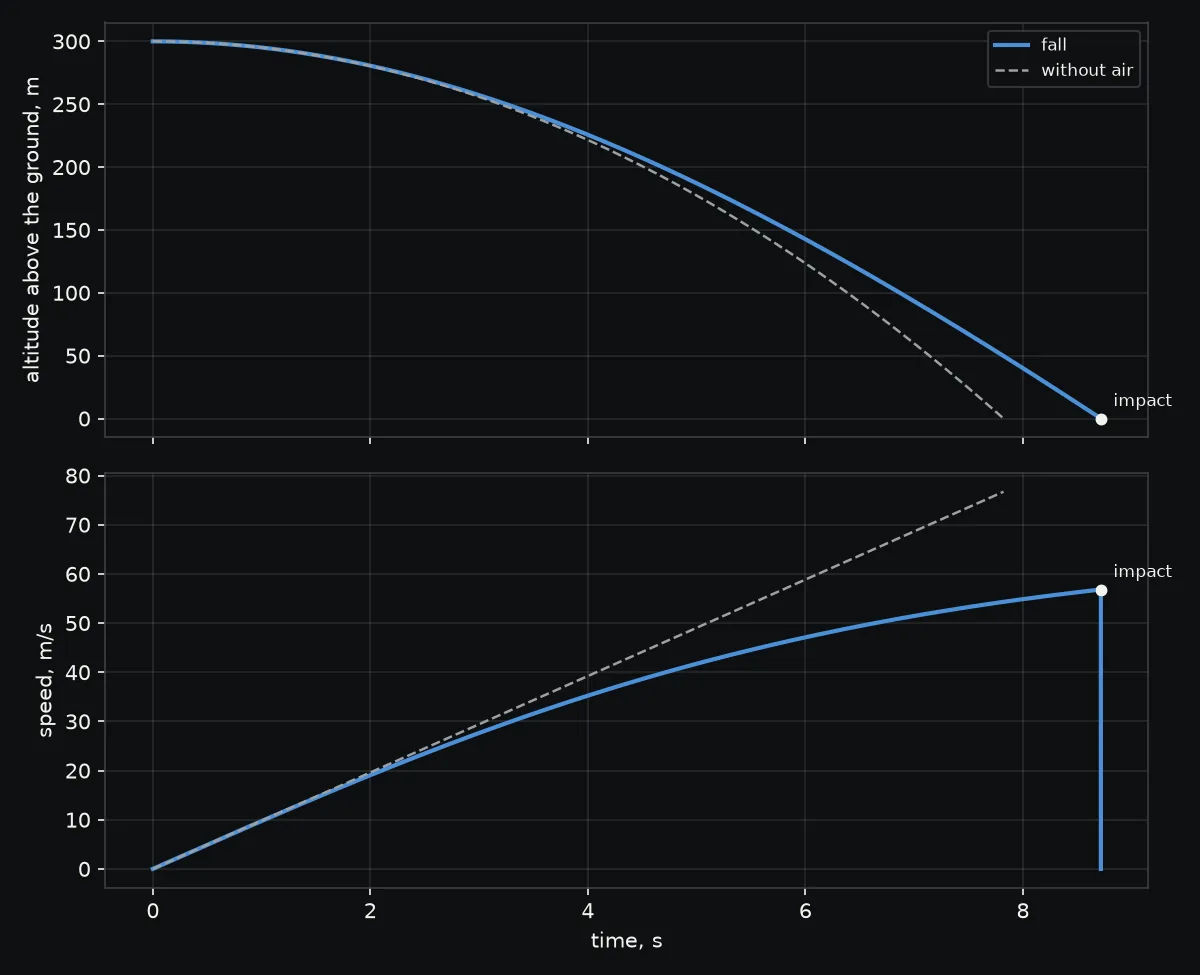
For the first two seconds the rock falls almost exactly as it would in a vacuum, because drag grows with the square of its speed. After that drag catches up, and by the ground it takes a quarter off the impact speed and adds nearly a second to the fall. The same run with the air taken away and gravity held at its ground value lands when sqrt(2h/g) says it should, agreeing to more than ten digits, and every number above held when the flight was integrated again with a tolerance ten times tighter.
The trajectory is in output/trajectory.csv, one row per moment of the fall with time, height, speed,
acceleration, Mach number and dynamic pressure.
Run it yourself
$ git clone https://github.com/sohan-bhat/wobbl$ cd wobbl/examples/falling-rock && ./run.shThe part, the script and every output are in examples/falling-rock on GitHub.