
Circuits
Will this LED fry, what is the ripple and how hot does the MOSFET get?
You ask
Will a blue LED on 5 V with a 47 ohm resistor fry?
Wobbl runs
$ wobbl circuit led --set supply=5V --set resistor=47 --set led=blueChecks
- passhand calculation
- passpower balance
- infooperating limits
36.9 mA
LED current
FAILSThe LED fries: 36.9 mA through it, above its 30 mA rating (1.2x).
- LED current
- 36.9 mA
- Rating
- 30 mA
- Resistor power
- 63.9 mW
- Confidence
- high
Suggested fix
- Use a 91 ohm resistor
summary.txt
FAILS. The LED fries: 36.9 mA through it, above its 30 mA rating (1.2x). Confidence: high. passed hand calculation, power balanceLED current: 36.9 mArating: 30 mAresistor power: 63.9 mWLED power: 120 mW Checks: [pass] hand calculation: diode equation solved by hand gives 36.9 mA, ngspice 36.9 mA (5.4e-05% apart); the quick estimate (Vs - Vf)/R is 38.3 mA [pass] power balance: supply gives 184 mW = resistor 63.9 mW + LED 120 mW (5.4e-08% apart) [info] operating limits: LED 36.9 mA of 30 mA; resistor 63.9 mW of 250 mW Assumptions: - blue LED modeled with the diode equation: 3.2 V at 20 mA, ideality 2.7, series resistance 1.5 ohm. - Resistor 47 ohm exact, rated 0.25 W. - Room temperature, steady DC. Suggested fixes: - Use a 91 ohm resistor: Gives about 19.8 mA; it dissipates 35.6 mW, so a 0.25 W part is enough.Report: report.htmlYou ask
What is the ripple on this 12 V to 5 V buck at 2 A?
Wobbl runs
$ wobbl circuit buck --set vin=12 --set vout=5 --set current=2 \ --set frequency=500k --set inductor=10u --set capacitor=22u \ --set max_ripple=0.05Checks
- passhand calculation
- passsteady state
- passtime step convergence
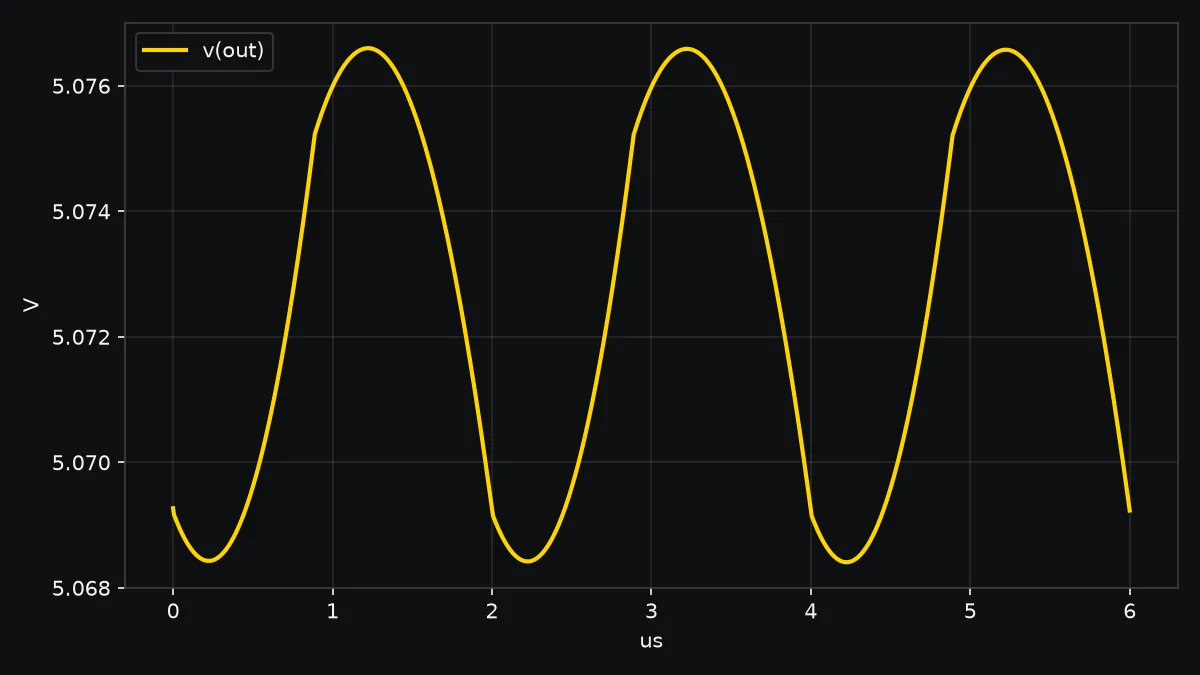
OKOutput ripple 8.56 mV peak to peak on 5.07 V (within the 50 mV limit); inductor ripple 0.604 A, peak 2.33 A.
- Ripple
- 8.56 mV
- Output
- 5.07 V
- Inductor ripple
- 0.604 A
- Confidence
- high
summary.txt
OK. Output ripple 8.56 mV peak to peak on 5.07 V (within the 50 mV limit); inductor ripple 0.604 A, peak 2.33 A. Confidence: high. passed hand calculation, steady state, time step convergenceripple: 8.56 mVoutput: 5.07 Vinductor ripple: 0.604 Aduty: 43.7% Checks: [pass] hand calculation: ideal waveform math (triangular inductor ripple dI = 0.583 A through C and ESR) gives 7.95 mV; ngspice 8.56 mV and 0.604 A (8% apart; the math ignores switch and diode drops) [pass] steady state: average output moved 0.0069% between the last two 20 cycle windows [pass] time step convergence: output ripple 0.00856 with the normal step, 0.00856 with half the step (0.0022% apart) Assumptions: - Open loop at the steady state duty cycle 43.7%; real controllers add their own ripple and transients. - Switch on resistance 0.05 ohm, Schottky catch diode. - Capacitor ESR 10 mohm, no ESL. Images: waveform: images/waveform.pngReport: report.htmlYou ask
How hot does this MOSFET get switching 15 A at 20 kHz in a 50 C box?
Wobbl runs
$ wobbl circuit mosfet --set current=15 --set rds_on=8m \ --set frequency=20k --set theta_ja=40 --set ambient=50Checks
- passhand calculation
- passthermal loop
110 C
Junction
OKJunction reaches about 110 C (1.51 W: 1.37 W conduction, 0.144 W switching) with 40 C/W to 50 C air; limit 150 C.
- Junction
- 110 C
- Limit
- 150 C
- Loss
- 1.51 W
- Confidence
- high
summary.txt
OK. Junction reaches about 110 C (1.51 W: 1.37 W conduction, 0.144 W switching) with 40 C/W to 50 C air; limit 150 C. Confidence: high. passed hand calculation, thermal loopjunction: 110 Climit: 150 Closs: 1.51 Wtheta JA: 40 C/W Checks: [pass] hand calculation: conduction loss I_rms^2 R = 0.903 W; ngspice average of V x I = 0.903 W (0.00079% apart) [pass] thermal loop: junction settles at 110 C after the on resistance warms up (12.1 mohm hot) Assumptions: - On resistance 8 mohm at 25 C rising 0.6% per C. - Switching loss from 40 ns edges: 0.5 V I (tr + tf) f. - Junction to air 40 C/W (datasheet, no heatsink unless included).Report: report.htmlAbout this example
These are three everyday circuit questions, each answered with ngspice and checked against the textbook answer computed independently.
| Question | Answer | Checks |
|---|---|---|
| Will a blue LED on 5 V with a 47 ohm resistor fry? | Yes, 36.9 mA goes through a 30 mA LED, and Wobbl suggests 91 ohm for about 20 mA | the diode equation by hand gives 36.9 mA and ngspice 36.9 mA, and the supply’s power equals the resistor’s plus the LED’s |
| What is the ripple on a 12 V to 5 V buck at 2 A, 500 kHz, 10 uH, 22 uF? | 8.56 mV peak to peak with 0.60 A of inductor ripple, within a 50 mV limit | the ideal triangular ripple math gives 7.95 mV, 8% apart because of the switch and diode drops, the output reached steady state, and the ripple is the same at half the time step |
| How hot does a MOSFET get switching 15 A at 20 kHz in a 50 C box with 40 C/W to air? | About 110 C at the junction from 1.51 W, under the 150 C limit with margin | the conduction loss I_rms^2 R matches the simulated V x I to 0.001%, and the junction temperature is iterated with the on resistance rising 0.6% per C |
Each folder (led/, buck/, mosfet/) holds report.html, summary.txt, outcome.json, the
netlist Wobbl generated, and a waveform plot where the analysis is in time.
Run it yourself
$ git clone https://github.com/sohan-bhat/wobbl$ cd wobbl/examples/circuits && ./run.shThe part, the script and every output are in examples/circuits on GitHub.