
Propane flame
How hot does a propane flame in air get, and how much CO and NO does it make?
You ask
How hot does a propane flame in air get, and how much CO and NO does it make?
Wobbl runs
$ wobbl flame propane --phi 1 --pressure "1 atm" --temperature "25 C"Checks
- passelement balance
- passenergy balance
- passthermo data
- passno dissociation bound
- passflammability
OKAdiabatic flame temperature 2266 K (1992 C) for propane in air at an equivalence ratio of 1, with 1.25% CO and 0.234% NO at equilibrium.
- Flame temperature
- 2266 K
- Equivalence ratio
- 1
- CO
- 1.25%
- Confidence
- high
summary.txt
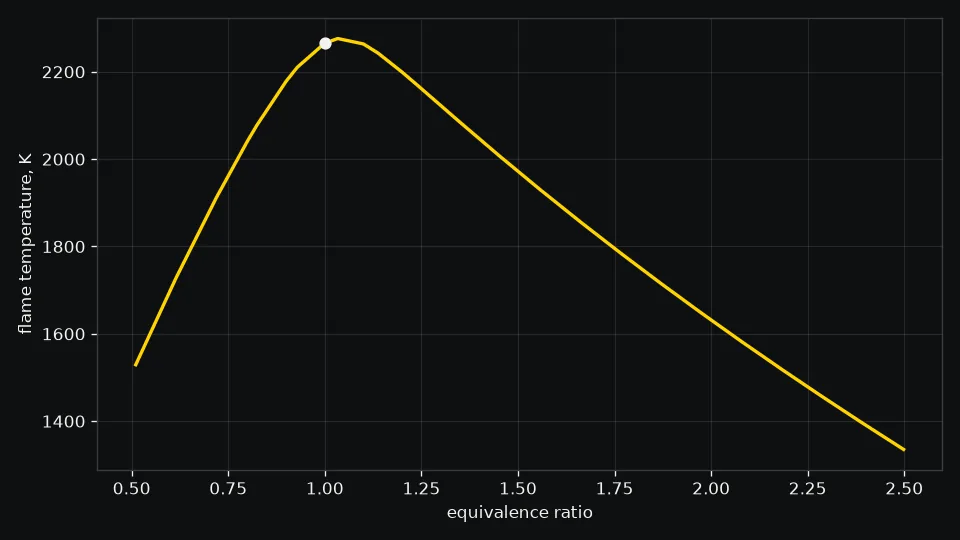
OK. Adiabatic flame temperature 2266 K (1992 C) for propane in air at an equivalence ratio of 1, with 1.25% CO and 0.234% NO at equilibrium. Confidence: high. passed element balance, energy balance, thermo data, no dissociation boundflame temperature: 2266 Kequivalence ratio: 1CO: 1.25%NO: 0.234% Checks: [pass] element balance: every element of the reactants is in the products to 6e-16 [pass] energy balance: the products at 2266 K hold the reactants' enthalpy to 2e-09 of cp T [pass] thermo data: GRI-Mech 3.0's own thermodynamic data give 2266 K for the same flame, 0.0694 K from NASA's (0.0031% apart) [pass] no dissociation bound: burning completely to CO2 and H2O with nothing breaking apart would reach 2392 K, and dissociation takes 126 K off it [pass] flammability: propane burns in air from 2.1% to 9.5% by volume, an equivalence ratio of 0.51 to 2.50, and this mixture is 4.03% fuel Assumptions: - Propane (C3H8) and air as O2 + 3.76 N2 at 298 K and 101 kPa, fully mixed. - Adiabatic and at constant pressure, with the products in chemical equilibrium on NASA's thermodynamic data (McBride, Gordon and Reno, NASA TM-4513). A real flame loses heat by radiation and to walls, so its peak runs below this temperature. - Equilibrium NO is an upper bound on what a flame makes, since forming NO takes longer than most flames last. Images: sweep: images/sweep.pngReport: report.htmlAbout this example
This is propane mixed with exactly the air it needs, an equivalence ratio of 1, at 1 atm and 25 C, as in a torch or a premixed burner. Wobbl burns it to chemical equilibrium on NASA’s thermodynamic data with Cantera.
| Result | Value |
|---|---|
| Adiabatic flame temperature | 2266 K (1992 C) |
| Without dissociation | 2392 K, so breaking CO2 and H2O apart at the flame takes 126 K off |
| GRI-Mech 3.0’s own data | 2266 K, 0.07 K from NASA’s |
| Equilibrium CO and NO at the flame | 1.25% and 0.234% |
| Flammability | 4.03% propane, inside the 2.1% to 9.5% it burns over in air |
The flame is hottest just rich of stoichiometric, near an equivalence ratio of 1.05, and cools
steeply on either side, which is why a burner runs lean to keep its walls and its NO down. The
temperature is an upper bound for a real flame, which loses heat by radiation and to the burner, and
the equilibrium NO is more than a flame makes in the few milliseconds the gas spends in it. For a
flame that has to stay under a temperature, wobbl flame propane --limit "1800 C" finds the leaner
mixture that meets it.
Run it yourself
$ git clone https://github.com/sohan-bhat/wobbl$ cd wobbl/examples/propane-flame && ./run.shThe part, the script and every output are in examples/propane-flame on GitHub.