
KNSB motor
Will this 54 mm KNSB motor hold its casing, and what thrust curve does it give?
You ask
Will this 54 mm KNSB motor hold its casing, and what thrust curve does it give?
Wobbl runs
$ wobbl motor motor.tomlChecks
- passtime step convergence
- passmass balance
- passclosed form
- passgeometry
- passchemistry
- passburn rate data
- warnerosive burning
- passcasing
- passKn
- passnozzle
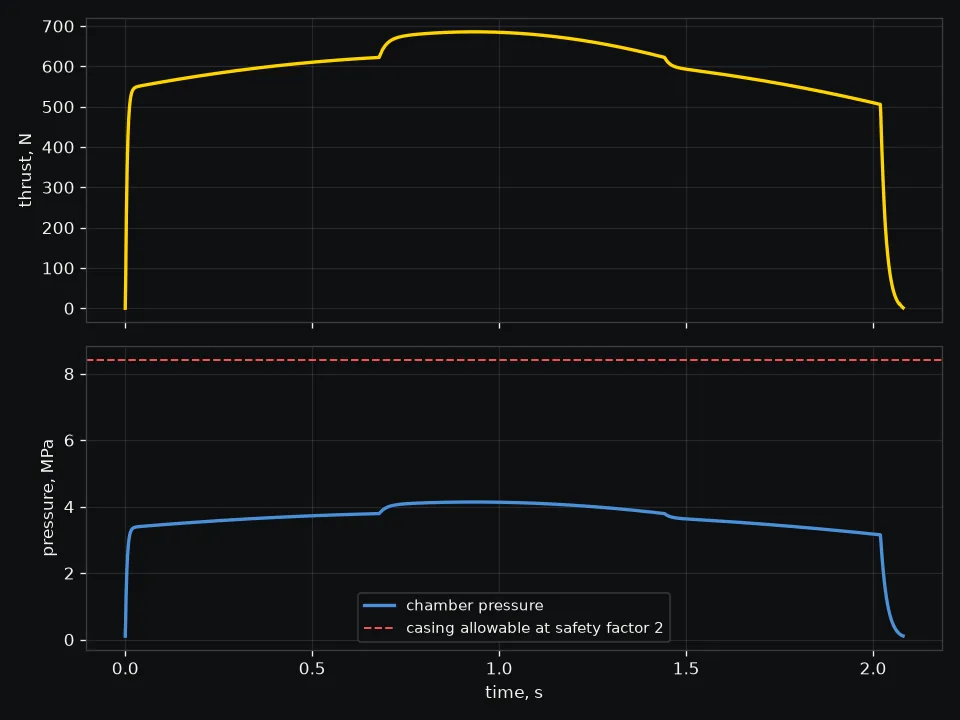
MARGINALPeak chamber pressure 4.14 MPa against a casing that yields at 16.8 MPa, a safety factor of 4.07 (target 2). J602 motor, 1238 N s over 2.06 s at 120 s Isp.
- Peak pressure
- 4.14 MPa
- Casing safety factor
- 4.07
- Total impulse
- 1238 N s (J602)
- Confidence
- medium
Suggested fix
- Open the cores to 23.5 mm
summary.txt
MARGINAL. Peak chamber pressure 4.14 MPa against a casing that yields at 16.8 MPa, a safety factor of 4.07 (target 2). J602 motor, 1238 N s over 2.06 s at 120 s Isp. Confidence: medium. erosive burning: the narrowest port is 1.59 times the throat area at ignition and the peak mass flux down the cores is 2336 kg/(m2 s), against the usual limits of 2 and 1406. Fast core flow changes the burn rate, which this model leaves out, so the real pressure early in the burn can differ from this predictionpeak pressure: 4.14 MPacasing safety factor: 4.07total impulse: 1238 N s (J602)burn time: 2.06 s Checks: [pass] time step convergence: total impulse 1238 N s with a 2.07 ms step and 1238 N s with 1.04 ms, peak pressure 4.14 MPa and 4.14 MPa, largest change 0.1% [pass] mass balance: 1.06 kg of propellant burned and 1.06 kg left through the throat, with 0.26 g still in the chamber (0.0057% apart) [pass] closed form: at peak pressure, where it holds still, Kn 314 gives (a rho c* Kn)^(1/(1-n)) = 4.14 MPa against the simulated 4.14 MPa (0.00017% apart). The textbook form that leaves out the gas filling the room the propellant leaves gives 4.2 MPa [pass] geometry: the burning area swept over the web matches the propellant's volume to 0.022% (worst grain, BATES 48 mm with a 16 mm core, 75 mm long) [pass] chemistry: Cantera's equilibrium for knsb at the average 3.72 MPa gives 1591 K, 39.7 kg/kmol and c* 907 m/s against the propellant data's 908 m/s (0.097% apart), with its elements and energy balanced to 8e-16 and 7e-13. The ideal Isp at this nozzle is 142 s frozen and 144 s shifting, and the motor delivers 120 s, 84% of frozen [pass] burn rate data: the burn runs from 1.26 MPa to 4.14 MPa, inside the 0.103 MPa to 10.7 MPa the burn rate was measured over [warn] erosive burning: the narrowest port is 1.59 times the throat area at ignition and the peak mass flux down the cores is 2336 kg/(m2 s), against the usual limits of 2 and 1406. Fast core flow changes the burn rate, which this model leaves out, so the real pressure early in the burn can differ from this prediction [pass] casing: peak 4.14 MPa puts 67.8 MPa of hoop stress on the bore of the 54 mm Aluminum 6061-T6 casing with a 1.6 mm wall (65.7 MPa by the thin wall hand calculation P r / t), a safety factor of 4.07 on its 276 MPa yield against a target of 2. It yields at 16.8 MPa and bursts near 18.4 MPa by Barlow's formula on the tensile strength [pass] Kn: Kn runs from 276 at ignition to 314 at its peak and 260 near burnout, staying within 21% over the burn. This propellant reaches the casing's allowable 8.42 MPa at a Kn of 486 [pass] nozzle: area ratio 6.35 expands the gas to 99.7 kPa at the average chamber pressure, against 101 kPa outside (an area ratio of 6.27 would match it) Assumptions: - KNSB (65/35 potassium nitrate and sorbitol), 1750 kg/m3, burning at r = a P^n by its published law (burn rate from Nakka, KN-Dextrose and KN-Sorbitol Propellants, Burn Rate Experimentation (nakka-rocketry.net/bntest.html), Table 2, with T, M and k from Nakka's KN-Sorbitol data as listed in openMotor's KNSB preset). - The burning itself comes from that burn rate law, not resolved flame chemistry. Erosive burning, ignition delay, throat erosion and slag are not modeled. - c* 908 m/s from T 1600 K, M 39.9 kg/kmol and k 1.14. - Thrust from the ideal thrust coefficient for k 1.14 and area ratio 6.35, times 98.9% for a 12 degree cone and a nozzle efficiency of 0.85. - Every surface lights at once at ambient pressure, and the gas in the chamber is combustion gas from the start. - The casing is checked as a long tube under internal pressure at room temperature strength. Closures, retaining rings, bolts and the tube's heating are not checked, so line the casing and size those parts on their own. - Against two MIT static fires in Wobbl's validation the predicted peak pressure was 7% low on one and 12% high on the other, so keep the casing's safety factor margin for what this model leaves out. Suggested fixes: - Open the cores to 23.5 mm: That gives a port to throat ratio of 3.42 and a peak core mass flux of 1377 kg/(m2 s). Simulated, the peak pressure is 5 MPa with 1083 N s (J765), since a wider core carries less propellant. Images: burn: images/burn.pngReport: report.htmlAbout this example
This is an amateur design of five BATES segments of KNSB, the 65/35 potassium nitrate and sorbitol
propellant, each 48 mm across with a 16 mm core and 75 mm long, in a 6061-T6 aluminum tube 54 mm
across with a 1.6 mm wall. The nozzle has a 12.7 mm throat and a 32 mm exit. The design is in
motor.toml, and Wobbl models it as given.
| Result | Value |
|---|---|
| Motor | J602, 1238 N s over 2.06 s at 120 s delivered Isp |
| Peak chamber pressure | 4.14 MPa, at a Kn of 314, where a Kn of 486 would reach the casing’s allowable 8.42 MPa |
| Casing | 67.8 MPa of hoop stress at the bore, a safety factor of 4.07 on yield against a target of 2, yielding at 16.8 MPa and bursting near 18.4 MPa |
| Erosive burning | the ports are 1.59 times the throat area and the core mass flux peaks at 2336 kg/(m2 s), past the usual limits of 2 and 1406 |
| Chemistry | Cantera’s equilibrium for KNSB gives c* 907 m/s against the 908 m/s of the published data, and the motor delivers 84% of the ideal frozen Isp |
The casing holds with a wide margin, so the verdict is marginal only because of the narrow cores. Gas racing down 16 mm ports changes how fast the propellant burns early in the burn, which a burn rate law cannot capture. Wobbl steps the cores out and simulates each step, and opening all five to 23.5 mm brings the port ratio to 3.42 and the mass flux to 1377 kg/(m2 s). That fix trades some propellant for it, giving 1083 N s, and raises the peak pressure to 5 MPa, still with a safety factor over 3. The steps in the pressure trace come from Nakka’s published burn rate, which changes its exponent at 3.79 MPa.
The run checks itself before the verdict. Halving the time step moves the impulse, peak pressure and
burn time by at most 0.1%, the propellant burned matches what left through the throat to 0.006%,
the pressure at the peak sits on the closed form (a rho c* Kn)^(1/(1-n)), and the grain geometry
sweeps out its own volume. The output folder holds thrust.csv and a RASP motor.eng, which
wobbl motion flies when a rocket spec says design = "motor.toml" under [motor], and
playback.json, the burn frame by frame with each grain’s burning cross section, the chamber
pressure, thrust and the casing’s safety factor.
Run it yourself
$ git clone https://github.com/sohan-bhat/wobbl$ cd wobbl/examples/knsb-motor && ./run.shThe part, the script and every output are in examples/knsb-motor on GitHub.