
Circuits
Four ready made circuit checks and any netlist of your own, each run in ngspice and checked against the textbook.
An LED that might fry
$ wobbl circuit led --set supply=5V --set resistor=47 --set led=blueFAILS. The LED fries: 36.9 mA through it, above its 30 mA rating (1.2x). Checks: [pass] hand calculation: diode equation solved by hand gives 36.9 mA, ngspice 36.9 mA (5.4e-05% apart); the quick estimate (Vs - Vf)/R is 38.3 mA [pass] power balance: supply gives 184 mW = resistor 63.9 mW + LED 120 mW (5.4e-08% apart)The fix it suggests is a 91 ohm resistor, which gives about 19.8 mA. LED colors are red,
orange, yellow, green, blue, white, uv, ir, power-white and power-red, and vf= and imax=
override the forward voltage and the current rating.
Ripple on a buck converter
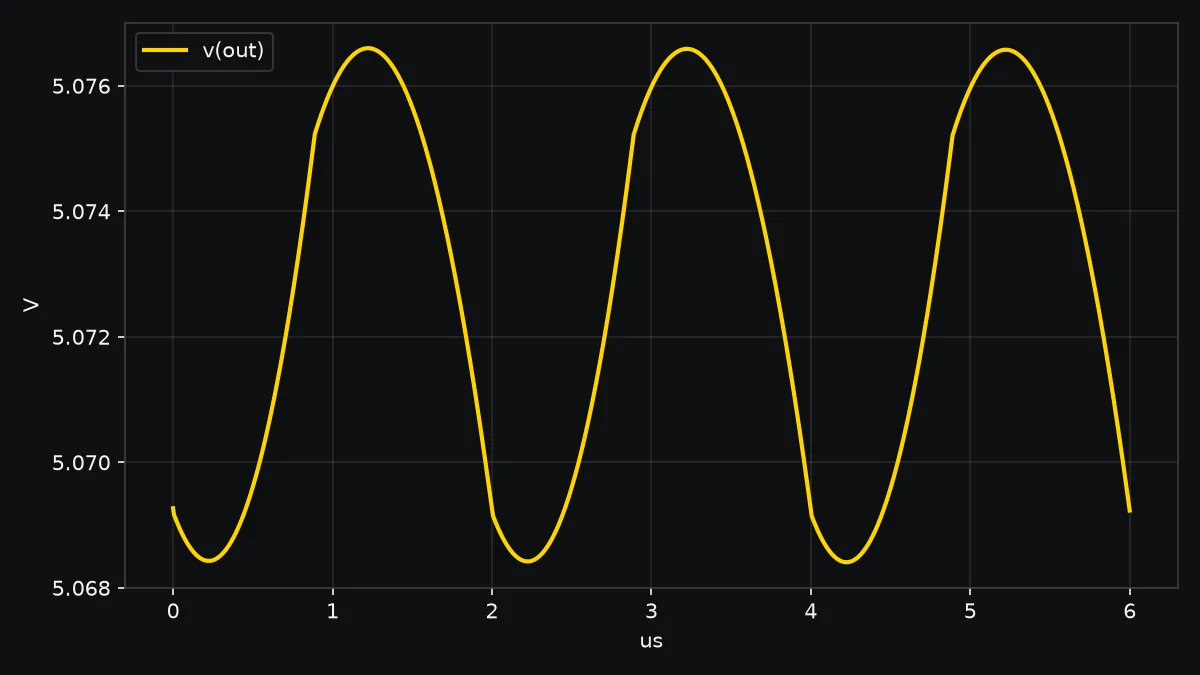
$ wobbl circuit buck --set vin=12 --set vout=5 --set current=2 --set frequency=500k \ --set inductor=10u --set capacitor=22u --set max_ripple=0.05This gives 8.56 mV peak to peak on 5.07 V, inside the 50 mV limit. The ideal formula says 7.95 mV, and the gap comes from the switch and diode drops that ngspice models and the formula leaves out. The run is repeated at half the time step and the ripple agrees to 0.0022%.
How hot a MOSFET gets
$ wobbl circuit mosfet --set current=15 --set rds_on=8m --set frequency=20k \ --set theta_ja=40 --set ambient=50The junction settles at about 110 C from 1.51 W of loss, under the 150 C limit. Wobbl iterates the junction temperature with the on resistance rising 0.6% per degree, which also catches thermal runaway.
Template parameters
Component values take SPICE style suffixes like 10k, 4k7, 22u or 2.2meg, and units
like 5V are fine too. max_ripple (in volts), cycles, duty, switching_time (in
seconds), ambient, theta_ja, tj_max and rds_tempco take plain numbers.
| Template | Parameters, with defaults |
|---|---|
led |
supply 5 V, resistor 150 ohm, led red, vf and imax from the color, rating 0.25 W for the resistor |
rc |
r 10k, c 10u, v 5 |
buck |
vin 12, vout 5, current 1, frequency 500k, inductor 10u, capacitor 22u, esr 0.01, rds 0.05, max_ripple 1% of vout, cycles 300 |
mosfet |
current 10, rds_on 0.01, vbus 12, frequency 0 for DC, duty, switching_time 40 ns, ambient 25, theta_ja 62, tj_max 150, rds_tempco 0.006 |
Verdicts
The LED check says ok, warm when the current is above 80% of the LED’s rating or the resistor
burns more than 60% of its own, or fails. The buck check says ok or fails against max_ripple. The MOSFET check says ok
when the junction stays at least 25 C under its limit, warm when it is closer than that, and
hot past the limit. The RC check reports the time constant and is always ok.
Any netlist
$ wobbl circuit board.cir --probe "v(out)" --probe "i(V1)"Wobbl runs the netlist as written, minus any .control block, and reports the minimum,
maximum, mean and final value of each probe with a plot. A netlist with a .tran analysis is
run again at half the time step to check that the peaks have settled. You have to name at
least one probe, since Wobbl cannot guess which signals matter to you. The
circuits example has all three templates above with their reports.