
Heat
A heat study tells you how hot the hottest point gets, and in a transient run, when it crosses your limit.
A chip on a heat sink
$ wobbl thermal heatsink.py -m 6063-t5 --power "15 W" \ --heat-faces "bottom and box 17.5,17.5,-1,42.5,42.5,0.5" \ --film "6 W/m2K @ all" --ambient "40 C" --radiation 0.85 --limit "85 C"The 15 W goes in through the 25 mm square the chip touches. Still air in a 40 C cabinet takes
heat away at about 6 W/(m2 K) and the anodized surface radiates. With no --duration the run
is steady state, and the heat sink example comes back like this.
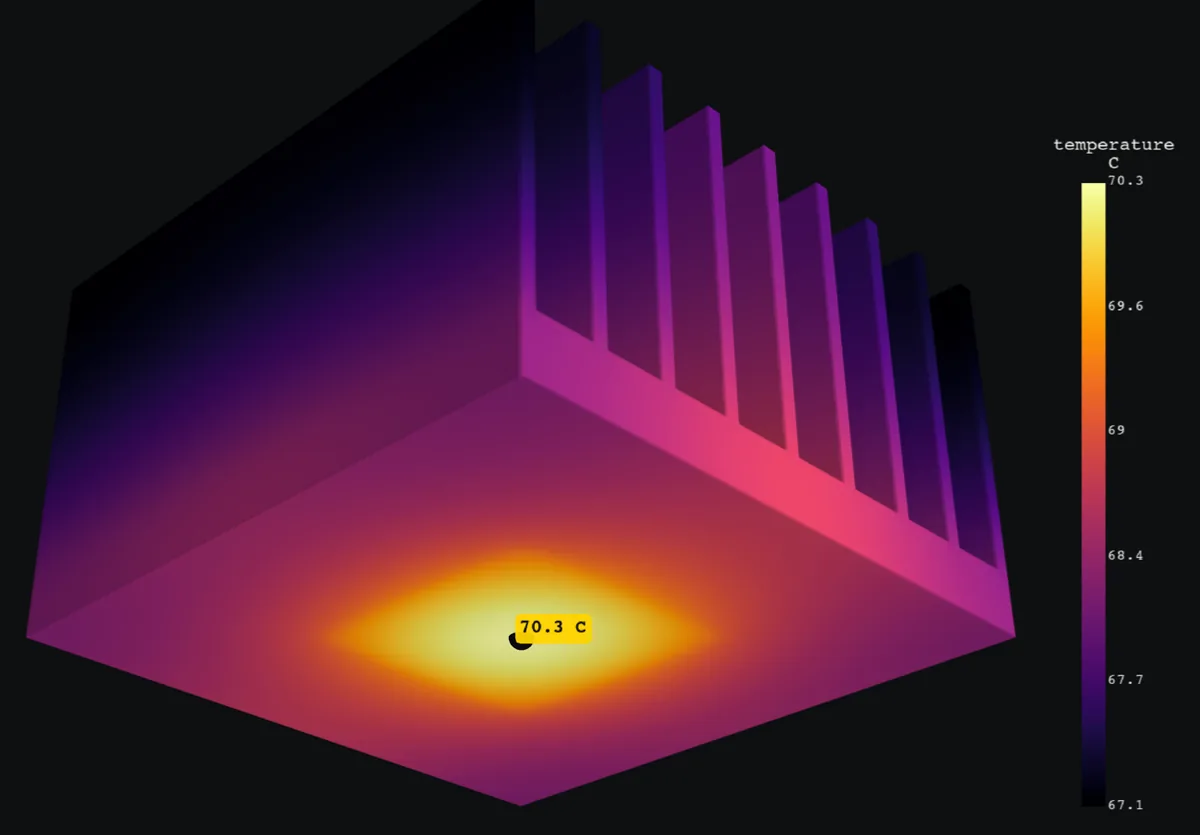
OK. Hottest point reaches 70.3 C (limit 85 C) at (30, 29.9, 0) mm at steady state. Confidence: high. passed mesh convergence, energy balance, hand calculation, units and sanityA battery pack over an hour
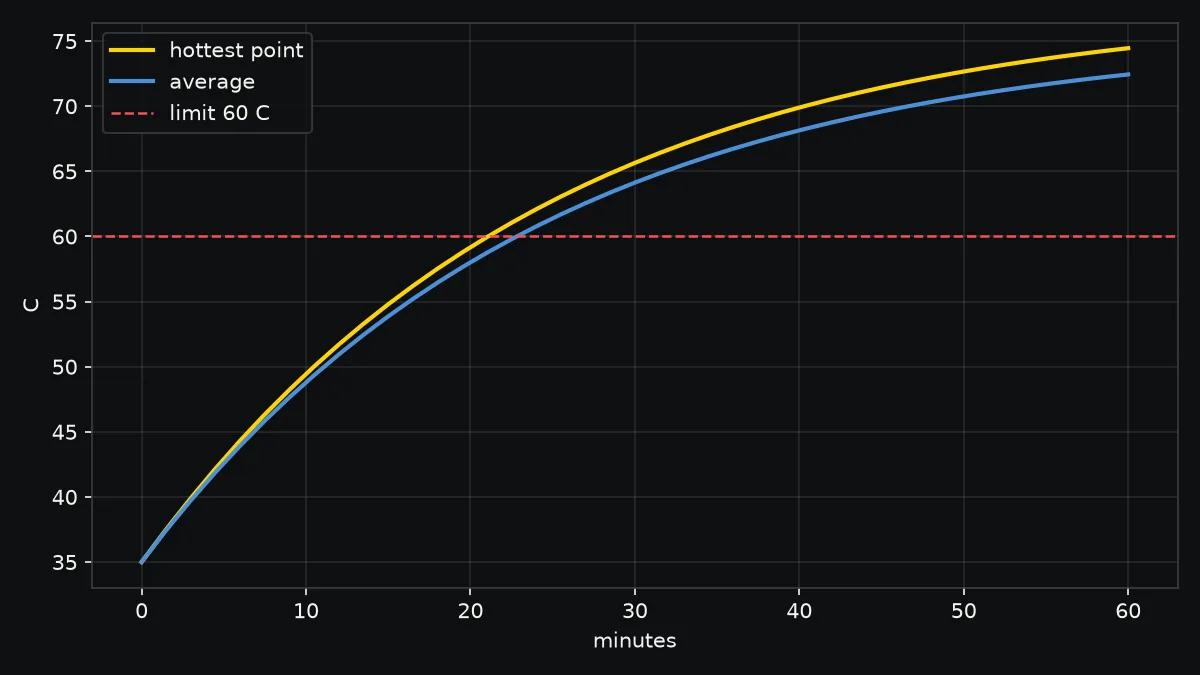
$ wobbl thermal pack.py -m li-ion-cell --power "6 W" --film "5 W/m2K @ all" \ --ambient "35 C" --radiation 0.9 --duration "60 min" --limit "60 C"--duration makes it a transient run that starts at the air temperature, and Wobbl reports
when the limit is crossed. The battery pack example, a 2S2P pack in
a sealed box, passes 60 C after about 21 minutes and reaches 74.5 C at the hour, so the
verdict is hot.
A part set on a hot surface
$ wobbl thermal plate.step -m 6061-t6 --fixed-temp "120 C @ bottom" \ --film "10 W/m2K @ top" --ambient "20 C" --duration "5 min"The plate starts at the 20 C air temperature, and its bottom is held at 120 C from the start. A held face that jumps all at once would move the nodes next to it by a fixed amount however short the time step, so Wobbl ramps it in a straight line from the starting temperature to its target over a very short time instead. That time is a tenth of the time heat takes to cross the smallest element at the face, which is quicker than the mesh can resolve, or a thousandth of the run if that is shorter. Over a long run it can be a little longer, because CalculiX never takes a time step under a millionth of the run, and the result’s assumptions say how long the ramp was and why. Here it is 0.06 s of a 5 minute run.
A face that jumps also gets extra saved times through the ramp and the fast flow of heat just after it, and smaller time steps when the jump is under 100 C, so a 20 C jump is followed as closely as a 100 C one. Several held faces can each jump to their own temperature, such as a hot end and a cold end on a part that starts somewhere in between.
Choosing the inputs
| Input | How to set it |
|---|---|
| heat made in the part | --power "12 W", spread evenly through the volume |
| heat from a chip | --power together with --heat-faces on the faces it touches |
| cooling by air or liquid | --film, repeatable, with roughly 5 W/(m2 K) for still air in a box, 10 for open air, 25 for a small fan, 60 for strong forced air and 500 for water |
| air temperature | --ambient, 25 C unless you say otherwise |
| a held temperature | --fixed-temp "40 C @ bottom" |
| radiation | --radiation 0.9 for painted or plastic surfaces, off by default |
| the limit | --limit "60 C", or the material’s own service limit |
A film can carry its own air temperature, as in --film "25 W/m2K at 30 C @ top". Without
any --film, Wobbl assumes open air at 10 W/(m2 K) on every face. Radiation acts on the same
faces as the films. wobbl thermal lists every option.
The verdict
| Verdict | When |
|---|---|
| ok | the hottest point stays at least 5 C under the limit |
| warm | it stays under the limit by less than 5 C |
| hot | it goes over the limit |
How heat answers are checked
The hottest point has to settle within 2% between meshes, and two meshes are enough here because temperature is a smooth field. In steady state, the heat going in has to match the heat leaving by convection, radiation and any held temperature faces to within 1%. In a transient, the heat made over the run and the heat let in or out by held faces have to match the heat the part stored plus the heat it shed along the way, to within 2% of the largest of those flows. The battery pack closes to 1%, and the plate on the hot surface to 0.8%. A lumped hand calculation treats the part as one uniform block and is compared with the surface average in steady state, or with the mean temperature over time in a transient. When radiation is off but the part runs hot, the result says how much heat radiation could shed. Checks has the details.